Database
Camera Collection Tracking Database Software
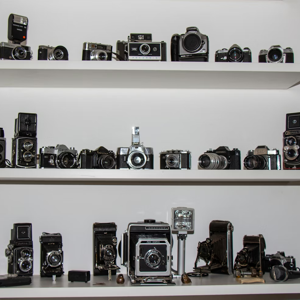
Tracker Ten can serve as a comprehensive and practical solution for anyone looking to organize, protect, and better understand a camera collection, whether that collection belongs to a private enthusiast, a professional photographer, a studio, or a small business dealing in photographic equipment. Camera collections often grow organically over time, accumulating bodies, lenses, accessories, and historical items that become difficult to track accurately. Without a dedicated system, important details such as value, condition, provenance, and location can easily be lost. Tracker Ten is designed to solve exactly these challenges by bringing structure, flexibility, and clarity to the process of managing a camera collection.
At its core, Tracker Ten functions as a centralized database where every camera and related item can be recorded in detail. Instead of relying on scattered spreadsheets, handwritten notes, or memory, collectors can store all relevant information in one place. Each camera body, lens, or accessory can be treated as an individual record, allowing the user to capture both technical specifications and contextual details. This centralized approach is especially valuable for collectors who own multiple camera systems, vintage equipment, or items acquired over many years from different sources.
One of the most immediate benefits of using Tracker Ten for a camera collection is insurance record keeping. Cameras and lenses are high-value items that are vulnerable to theft, damage, or loss. Insurance companies often require detailed documentation, including serial numbers, purchase prices, estimated current values, and photographic proof. Tracker Ten allows users to store serial numbers, cost, value, and purchase dates alongside multiple images of each item. In the event of a claim, this information can be quickly retrieved and presented in a professional format, reducing stress and improving the likelihood of a smooth insurance process.
For collectors who also use their equipment professionally or operate a small photography-related business, Tracker Ten doubles as an inventory management tool. Cameras, lenses, flashes, and accessories can be tracked by location, making it easy to know whether an item is in a studio, on loan, packed for a shoot, or stored off-site. Fields such as quantity, condition, and location help prevent misplacement and ensure that valuable equipment is always accounted for. This is particularly useful for studios with multiple photographers or shared gear, where accountability and transparency are essential.
Click here to get a free demo of Tracker Ten for Camara Equipment.
The software’s flexible field structure is well suited to the diverse nature of camera equipment. Camera collectors often deal with a wide range of formats and eras, from modern digital bodies to medium format film cameras and vintage large-format systems. Tracker Ten supports sample fields such as origin, type, brand name, brand model, media type, negative size, focal length, and lens aperture, making it easy to record both modern technical specifications and historical characteristics. This flexibility ensures that the software adapts to the collection, rather than forcing the collection into a rigid template.
Condition tracking is another important aspect of managing a camera collection, and Tracker Ten handles this effectively. Cameras are precision instruments, and their value is closely tied to their physical and functional condition. By recording condition details and updating them over time, collectors can maintain an accurate picture of wear, servicing history, and overall usability. Rich text format notes allow for detailed descriptions, such as shutter accuracy, cosmetic wear, or recent repairs, which are far more informative than a simple numeric rating.
Accessory tracking further enhances the usefulness of Tracker Ten for camera collections. Cameras rarely exist in isolation; they are supported by lenses, filters, straps, cases, batteries, chargers, tripods, and other accessories. Tracker Ten makes it possible to associate these accessories with specific camera bodies or treat them as standalone items. This helps ensure that complete kits remain intact and that smaller, easily misplaced items are not overlooked. For collectors with rare or original accessories, this feature adds significant organizational value.
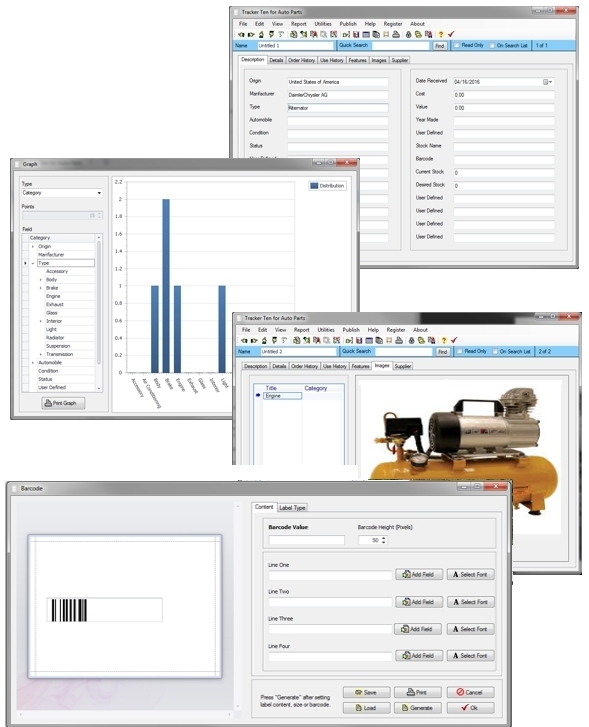
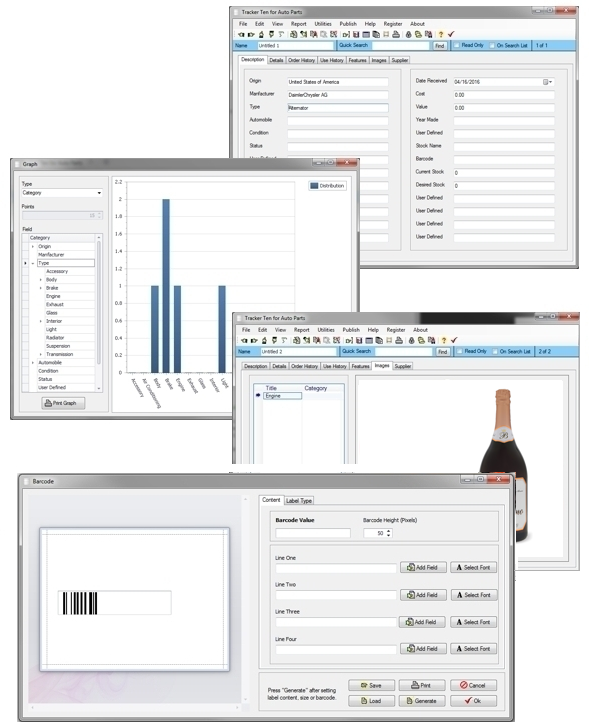
The inclusion of multiple image support is especially valuable for camera collectors. High-quality images of each item can be attached directly to its record, providing visual documentation of condition, markings, and unique features. This is useful not only for insurance and resale purposes, but also for personal reference. Over time, these images can form a visual history of the collection, capturing changes in condition or configuration. For vintage or collectible cameras, photographs of serial numbers, engravings, or original packaging can be invaluable.
Tracker Ten’s powerful search engine makes navigating a large camera collection efficient and intuitive. Instead of scrolling through long lists or flipping through notebooks, users can instantly locate items based on brand name, model, serial number, focal length, or any other recorded field. This capability becomes increasingly important as a collection grows. Whether a collector wants to find all cameras from a particular manufacturer, identify lenses with a specific aperture, or locate items stored at a certain location, the search functionality saves time and reduces frustration.
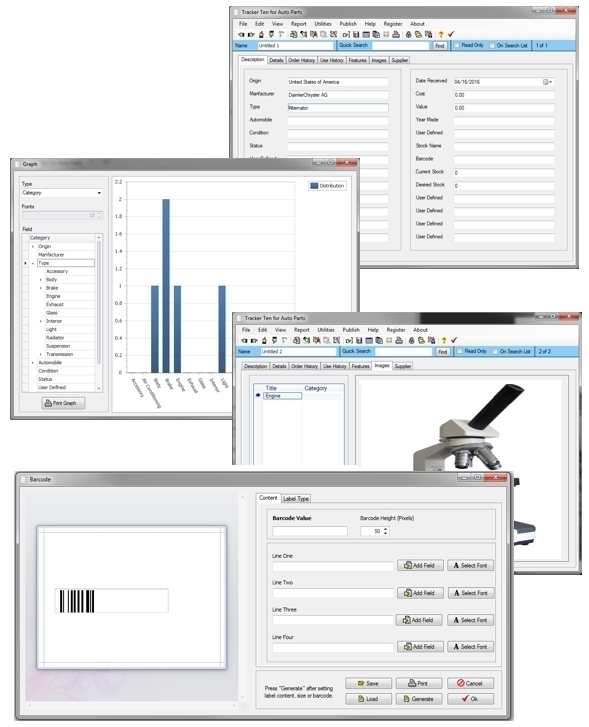
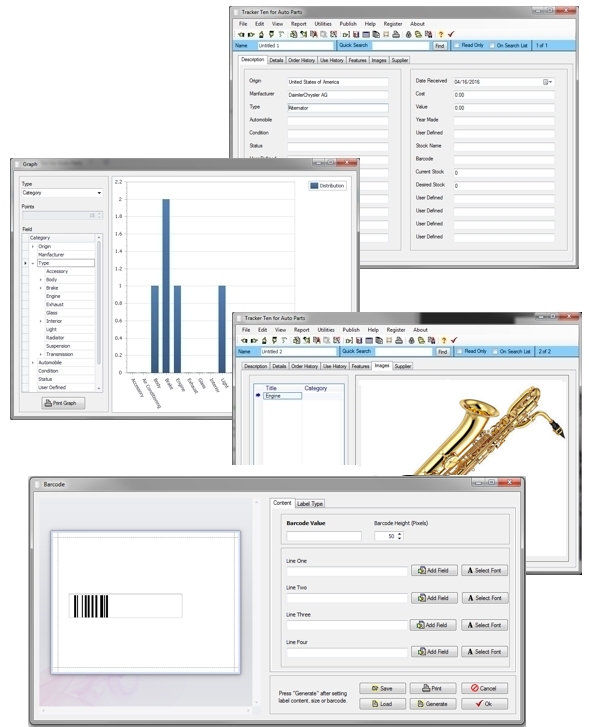
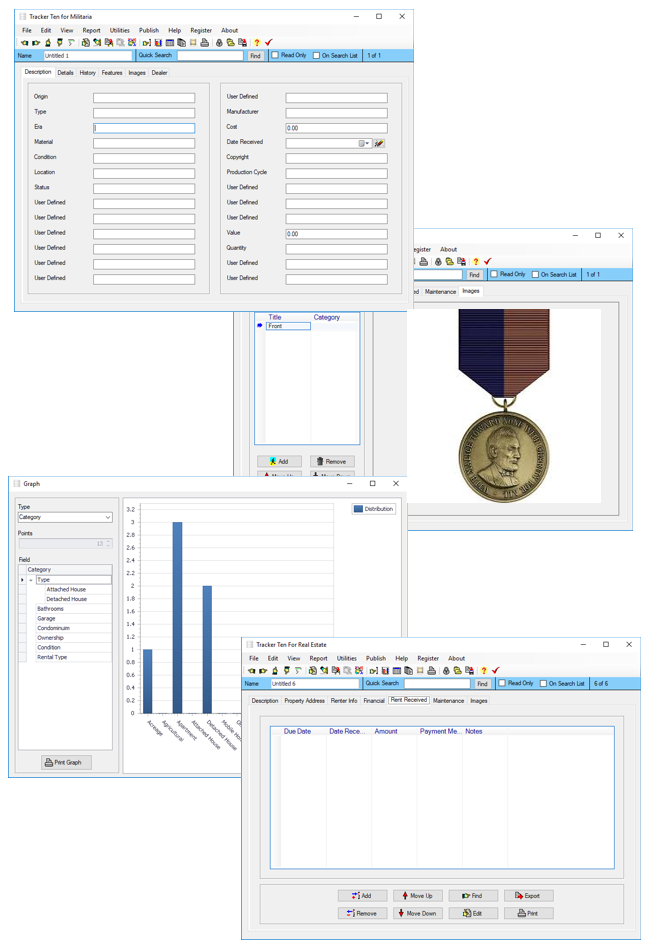
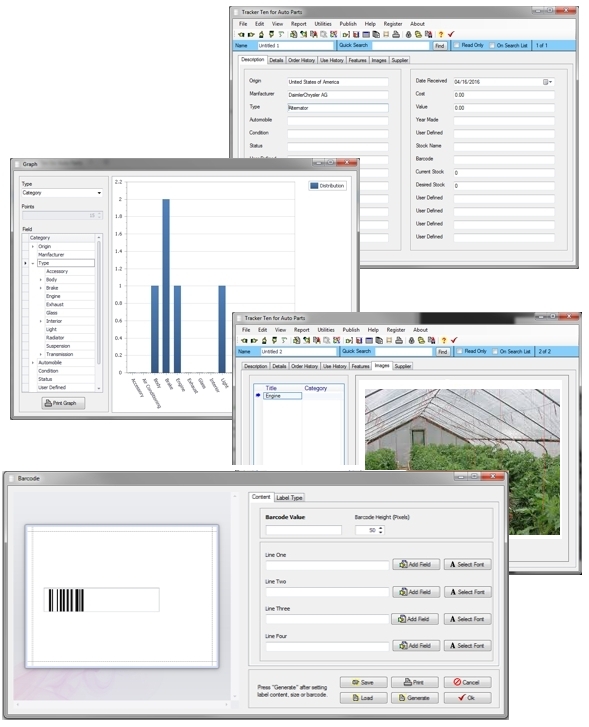
Reporting and data visualization features add another layer of insight. Tracker Ten can generate reports that incorporate full-color images, making them suitable for presentations, documentation, or personal review. Collectors can create reports focused on value, condition, or acquisition dates, helping them understand how their collection has evolved. Data graphing allows trends to be visualized, such as changes in total collection value over time or the distribution of equipment by brand or format. These insights can inform purchasing decisions, insurance coverage adjustments, or downsizing strategies.
For collectors transitioning from another system, Tracker Ten offers a smooth migration path. Many camera enthusiasts start by tracking their gear in spreadsheets or other databases. Tracker Ten’s support for comma delimited import means that existing data can be transferred quickly and efficiently. By exporting current records to a compatible format, users can import them into Tracker Ten in minutes, preserving their existing work while gaining access to more advanced features. This ease of transition lowers the barrier to adoption and makes the software accessible even to those who are not technically inclined.
Customization is another strength that makes Tracker Ten well suited to camera collections. No two collections are exactly alike, and collectors often have unique ways of categorizing and valuing their equipment. Tracker Ten allows users to customize fields, views, and layouts to match their personal workflow. A collector focused on historical cameras might emphasize fields like circa and origin, while a professional photographer might prioritize cost, value, and usage status. This adaptability ensures that the software remains useful as needs change.
Ease of use plays a critical role in long-term adoption, and Tracker Ten is designed to be approachable even for users with limited technical experience. Data entry is straightforward, and the interface is designed to minimize complexity while still offering depth. This is important because a tracking system is only effective if it is kept up to date. When adding a new camera or updating a record is quick and intuitive, users are more likely to maintain accurate and complete data.
Tracker Ten also supports data export, which is useful for backup, sharing, or integration with other systems. Camera collectors may want to share inventory lists with insurers, partners, or buyers, or simply keep an external backup for peace of mind. Exporting data ensures that information is never locked into a single system and can be reused as needed.
In practical terms, using Tracker Ten to track a camera collection transforms what might otherwise be a scattered assortment of equipment into a well-documented, organized asset. It provides clarity around what is owned, where it is located, what it is worth, and how it fits into the broader collection. This clarity benefits casual hobbyists, serious collectors, and professionals alike.
Ultimately, Tracker Ten offers more than just a database; it provides a framework for understanding and managing a camera collection with confidence. By combining detailed record keeping, flexible customization, visual documentation, and powerful search and reporting tools, it addresses the real-world needs of camera collectors. Whether the goal is organization, insurance protection, business inventory management, or simply gaining a deeper appreciation of a carefully curated collection, Tracker Ten offers a practical and effective solution.
Looking for windows database software? Try Tracker Ten
- PREVIOUS Client Tracking Software for Consultants Saturday, August 26, 2023
- NextModel Train Collecting Friday, July 28, 2023