Database
What is a Database
Whether you are trying to understand basic database concepts for your home or business, preparing for a technical interview, studying for school, or simply curious about how modern software systems work, this article is designed to give you a comprehensive and practical understanding of databases. Databases form the foundation of nearly every digital system we interact with today, from social media platforms and online stores to banking systems, hospitals, and schools. Understanding what a database is, how it works, and why it matters will give you valuable insight into how information is created, stored, protected, and used in the modern world.
At a high level, a database is about organization. Just as filing cabinets, spreadsheets, and ledgers were used in the past to keep information structured and accessible, databases are the modern electronic equivalent. However, databases go far beyond simple storage. They are optimized for speed, reliability, accuracy, scalability, and security, making them essential for handling large volumes of information and supporting real-time operations.
Database Quick Definition
A database is an organized collection of electronically stored information that can be easily accessed, managed, and updated. Databases are designed to store data in a structured way so that it can be retrieved efficiently, even as the amount of data grows very large. While this definition sounds simple, databases come in many forms and can be tailored to meet vastly different requirements.
There are many different types of databases, including centralized databases, distributed databases, relational databases, NoSQL databases, time-series databases, graph databases, and more. A single database system may fall into more than one category. For example, a system can be both distributed and relational, or centralized and NoSQL. Data repositories and data warehouses are simply collections of databases that are stored and accessed together to support analytics, reporting, and long-term storage.
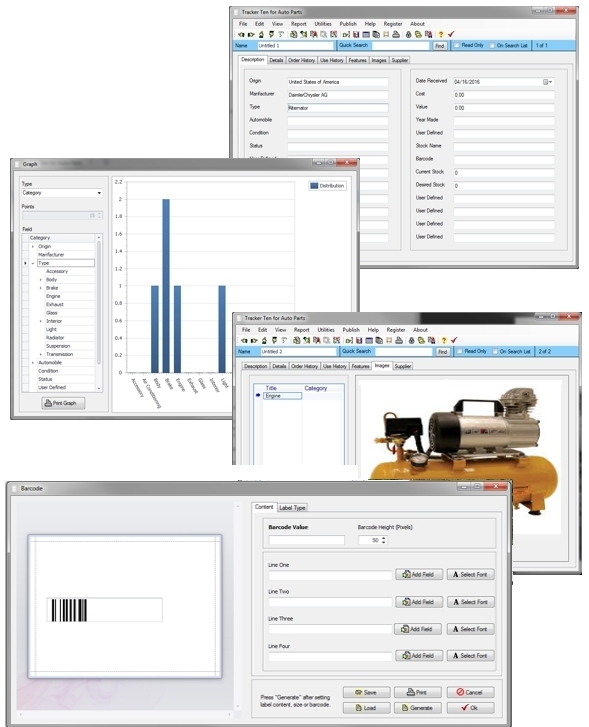
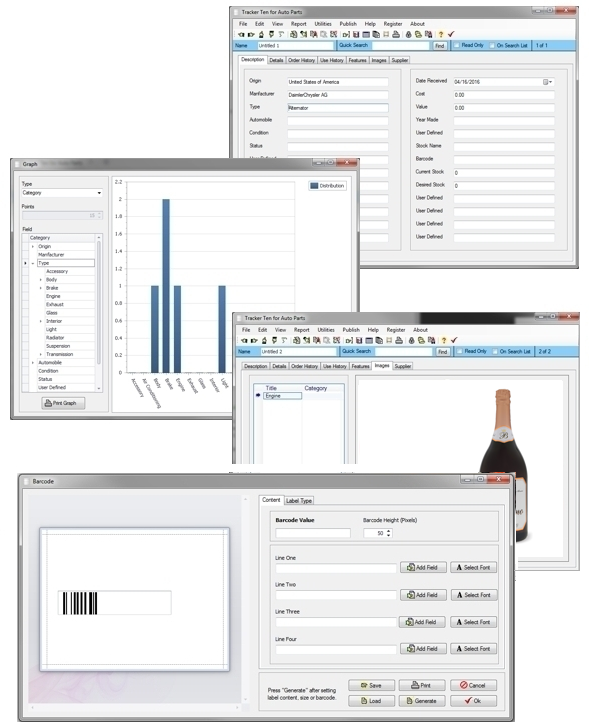
Databases are used in nearly every industry and application imaginable. Common examples include ecommerce platforms tracking inventory and customer orders, sales teams tracking leads and customer interactions, hotels tracking guests and reservations, hospitals tracking patients and medical records, warehouses tracking products and shipments, banks managing financial transactions, and schools tracking students, courses, and grades. If you explore our Tracker Ten software catalog, you will see specialized databases designed for a wide range of real-world applications. If you do not see your specific use case listed, please contact us, as custom database solutions are often possible.
Database operations can be performed using general-purpose programming languages such as Python, Java, JavaScript, or C#, or they can be performed using specialized database languages like SQL (Structured Query Language). Regardless of how a database is accessed, most databases rely on a processing model known as Online Transaction Processing, or OLTP. OLTP systems are designed to handle frequent, small transactions such as inserting new records, updating existing data, and deleting outdated information.
OLTP operations happen in real time, which is critical for many applications. For example, when you purchase an item in an online store, the available inventory must be updated immediately so that another customer cannot buy the same item at the same time. Similarly, when a bank processes a withdrawal, the account balance must be updated instantly to ensure accuracy and prevent overdrafts. Databases are optimized to perform these operations quickly, reliably, and safely.
Information stored in a database is optimized for these types of operations and is typically designed to be ACID compliant. ACID stands for Atomicity, Consistency, Isolation, and Durability. Atomicity ensures that a transaction is completed fully or not at all. Consistency ensures that the database remains in a valid state. Isolation ensures that transactions do not interfere with one another. Durability ensures that once a transaction is committed, it will not be lost, even in the event of a power failure or system crash.
Databases may also use performance-enhancing techniques such as caching. Caching involves storing frequently accessed data in faster memory so it can be retrieved more quickly. For example, a database might cache popular product listings or commonly used configuration data. While OLTP systems focus on real-time transactions, data warehouses use a different model known as Online Analytical Processing, or OLAP. OLAP systems are designed to analyze large volumes of data from multiple sources and provide insights, trends, and summaries rather than handling individual transactions.
Our Tracker Ten system uses a proprietary OLTP mechanism to add, modify, and delete items efficiently while maintaining data integrity and reliability.
Types of Database Applications
One of the most common types of databases is the relational database. A relational database stores information in tables that are related to one another through defined relationships. Each table consists of rows and columns, where rows represent records and columns represent attributes. For example, in a retail system, product information might be stored in one table, inventory levels in another, and supplier details in a third. These tables are linked together using keys, allowing the database to combine information as needed.
A key concept in relational databases is data normalization. Normalization is the process of organizing data to reduce redundancy and improve data integrity. Instead of storing the same information in multiple places, normalized databases store each piece of information once and reference it where needed. This makes updates easier, reduces storage requirements, and minimizes the risk of inconsistent data.
Relational databases use SQL to query and manipulate data. SQL provides powerful operators for filtering, joining, aggregating, and analyzing information. Understanding relationships is central to working with relational databases. Common relationship types include one-to-one, one-to-many, and many-to-many relationships. A one-to-one relationship means that one record in a table corresponds to exactly one record in another table. A one-to-many relationship means that a single record in one table is associated with multiple records in another. A many-to-many relationship means that records in two tables can be associated with multiple records in each other.
If you choose to use a product like our Tracker Ten database, these relationships and normalization rules are handled automatically behind the scenes. Users do not need to worry about the technical details, as the system enforces consistency and structure for you.
Another important classification is centralized versus distributed databases. A centralized database stores all data in a single location. This location might be a cloud-based server, a local server, or even a single desktop computer. Centralized databases offer strong control and security, as all access goes through a single point. This makes it easier to monitor activity, enforce permissions, and maintain consistency.
Because all users work with the same data, centralized databases promote collaboration and ensure that everyone sees the same information. Our Tracker Ten system is an example of a centralized database, as all information is stored locally on your desktop system.
However, centralized databases also have disadvantages. They can be highly dependent on network connectivity, especially when hosted remotely. When many users or services try to access the same database at the same time, performance bottlenecks can occur. You may hear terms such as database I/O bottlenecks, memory bottlenecks, or microservice database contention. Addressing these issues can require hardware upgrades, database tuning, or architectural changes.
Another risk of centralized databases is that a single failure can affect the entire system. If the database becomes corrupted or unavailable, all dependent applications may stop functioning. Regular backups, redundancy, and monitoring are essential to mitigate these risks.
Distributed databases represent the opposite approach. In a distributed database, data is stored across multiple computers, often in different physical locations. This approach is useful for organizations that operate across multiple regions or countries. Distributed databases can improve availability, fault tolerance, and scalability, but they also introduce complexity in terms of synchronization, consistency, and management.
Our Tracker Ten system can be configured as a distributed solution by deploying separate database files at different locations. This can be especially effective for homogeneous distributed databases, where similar data is stored in multiple places. Heterogeneous distributed systems, where different sites store different types of data, are also possible but may require more customization. For more information, please contact us.
NoSQL Database vs Relational Database Performance
NoSQL databases are databases that do not store data in traditional relational table structures. Instead, they use alternative models such as document stores, key-value stores, column-family stores, and graph databases. Unlike relational databases, NoSQL systems are generally non-relational, meaning they do not enforce relationships between data items in the same way.
NoSQL databases are particularly useful when data does not fit neatly into a structured schema or when relationships between data items are minimal or highly flexible. For example, a collection of independent magazine articles or blog posts can be stored efficiently in a document-based NoSQL database. Another common use case is the storage of JSON data, where each record may have a different structure.
One of the major advantages of NoSQL databases is scalability. Many NoSQL systems are designed to scale horizontally, meaning that you can increase capacity simply by adding more storage or servers. This makes them attractive for applications that need to handle massive volumes of data or rapidly changing workloads. Additionally, many NoSQL databases are open source, which can reduce licensing costs.
However, NoSQL databases are not without trade-offs. They often sacrifice strict consistency or transactional guarantees in favor of performance and scalability. Managing and optimizing NoSQL systems can require significant expertise, particularly in distributed environments. Even though the software itself may be free, the operational complexity can result in higher overall costs.
Relational databases, on the other hand, excel at maintaining data integrity, enforcing rules, and handling complex queries involving relationships. They are often the best choice for applications that require strong consistency, well-defined schemas, and transactional reliability.
By using a database system like Tracker Ten, you can avoid the complexity of choosing, configuring, and maintaining low-level database technologies. The system provides a streamlined and user-friendly way to store and manage your data without requiring deep technical knowledge.
In summary, databases are the backbone of modern information systems. They provide the structure, reliability, and performance needed to manage data effectively at any scale. Whether you are running a small home inventory, managing a growing business, or supporting an enterprise application, understanding how databases work will help you make better decisions and use technology more effectively.
If you need help setting up a database for your business or organization, please contact us. We can often provide solutions that are simpler, more flexible, and more cost-effective than traditional enterprise offerings.
Looking for windows database software? Try Tracker Ten
- PREVIOUS Database Concurrency Saturday, May 11, 2024
- NextManaging Aquarium Equipment and Supplies Thursday, April 25, 2024